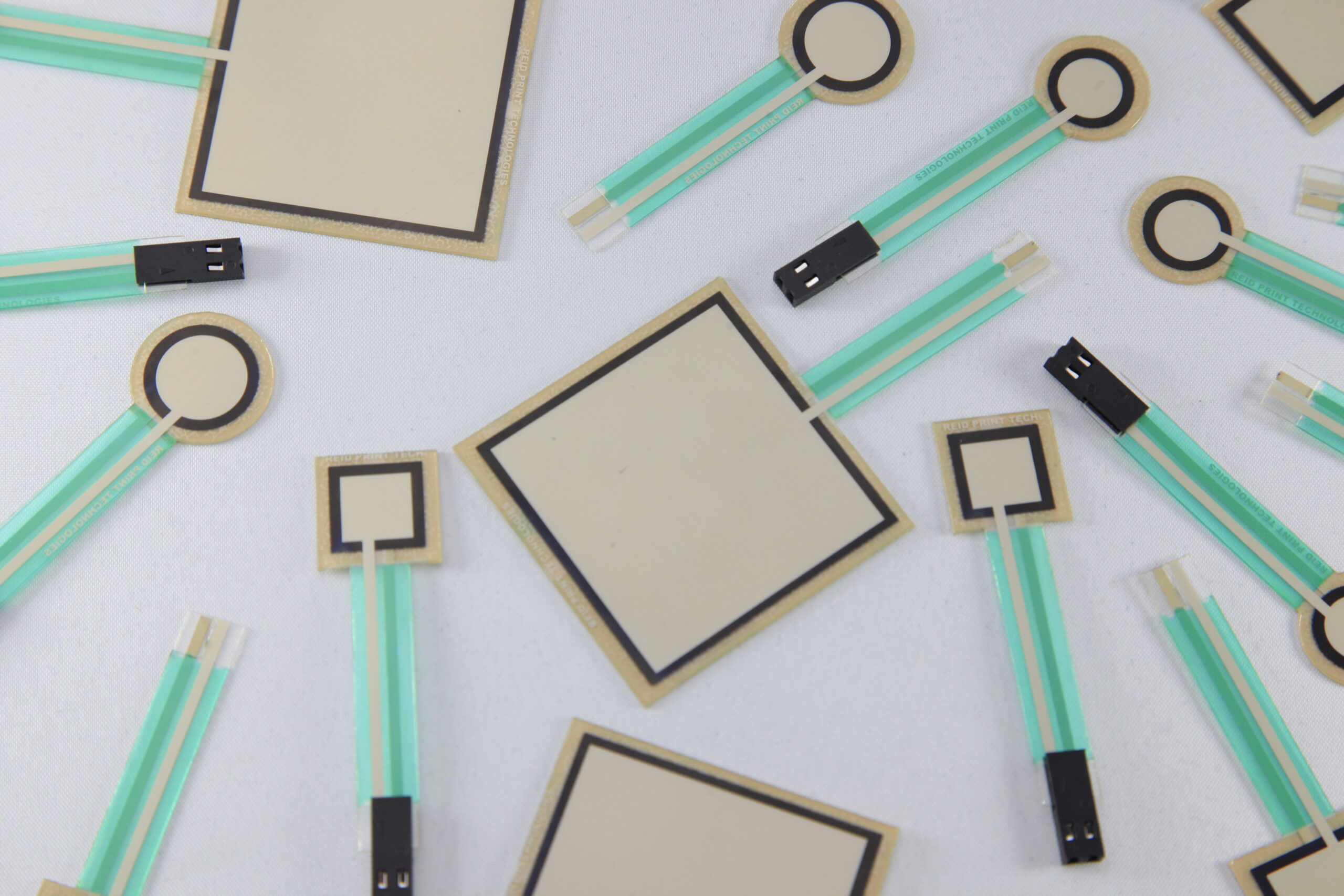
Force Sensing Resistors
Custom printed force sensing resistors that measure force and pressure by changing resistance under load. Made to order in a wide range of sizes, shapes and resistances, designed and manufactured in Brisbane.
Printed force sensors, made to your benchmark
Reid Print Technologies manufactures force sensing resistors to order, with a multitude of resistances, sizes, shapes and configurations on offer. An FSR is a pressure sensor that can be custom made to a wide range of benchmarks and resistances, giving you a paper-thin, low-cost way to measure force or pressure exactly where you need it.
The sensors are made by printing carbon-based specialised inks onto a flexible substrate, which lets them conform to curved and compact assemblies while continuing to sense reliably. Full customisation of the active area, size, shape and connector means the sensor is built around your design rather than the other way around.
This is the technical home of Reid's force sensing capability. To see the technology applied in body-worn devices, visit Wearable & Stretchable Electronics, our flagship wearable application. For the wider printed-sensing capability it belongs to, see Flexible Printed Sensors.
Two ways to sense force
A force sensing resistor works by changing its electrical resistance as force is applied to the printed sensing area, so a straightforward circuit can turn that change into a force or pressure reading. There are two main types, and Reid manufactures both so the mode can be matched to your force range.
Shunt Mode
Shunt Mode resistors detect a wide range of forces, making them the general-purpose choice for pressure mapping and load measurement across broad force ranges. Most of Reid's round, square and bar sensor series are Shunt Mode.
Thru Mode
Thru Mode resistors are more receptive to lighter forces, which suits delicate touch, light contact and low-pressure sensing. Reid's Thru Mode series cover applications where sensitivity to gentle loads matters most.
Device characteristics.
| Parameter | Value | Notes |
|---|---|---|
| Actuation force | 0.1 N | Force to trigger a response |
| Force sensitivity range | 0.01 to 10 N | Typical, per part (family capability spans about 0.3 to 50 N) |
| Force resolution | Continuous | Essentially infinite within range |
| Force repeatability, single part | ±2% | Typical |
| Force repeatability, part to part | ±6% | Typical |
| Off-state resistance | >10 MΩ | Unloaded (stand-off resistance) |
| Device thickness | 0.2 to 1.25 mm | Depends on design |
| Response time | <3 µs | Device rise time |
| Operating temperature | -30 to +70 °C | Rated operating range |
Full part-by-part specifications are published in our Force Sensing Resistors data sheet, available on the Downloads page.
The FSR 2000 series
A standard family of printed force sensing resistors in round, square, bar and directional formats, in both Shunt and Thru sensing modes. Every part is also made to order, so these series are a starting point rather than a limit.
| Series | Format | Mode | Description |
|---|---|---|---|
| FSR 2000 / 2010 / 2020 | Round pad | Shunt | 16 mm, 19 mm and 24 mm round sensors |
| FSR 2030 / 2040 / 2050 | Square pad | Shunt | 16 mm, 24 mm and 44 mm square sensors |
| FSR 2060 / 2070 / 2080 / 2090 | Round pad | Thru | Thru-mode sensors tuned for lighter forces |
| Bar / strip sensors | Bar | Shunt | Long-format bar sensors (for example 104 mm) for load distribution |
| FSR 2260 | Left-Right | Shunt | 39 mm dual-zone directional sensor |
Every series is made to order and offers three connector options: A (2.54 mm connector), B (bare flying tail, no connector) and C (solder pins). Active area, overall size, shape and resistance are all customised to your design.
Built on Reid's patented pressure sensor
This same printed force-sensing technology forms the basis of Reid's patented pressure sensor - the technology behind Calceus Health's Sensor Skins wearable. The underlying printed-sensor technology is protected by a granted United States patent, with Australian and New Zealand patent applications pending and expected to follow.
Where FSRs are used
Printed force sensing resistors show up wherever force or pressure needs to be measured in a thin, flexible, low-cost form. Common uses include podiatry and orthotics, hospital bed monitoring, inventory and control systems, robotics and IoT pressure mapping.
Printed Force Sensing Resistors


Force sensing resistor FAQs
What is a force sensing resistor (FSR)?
A force sensing resistor is a printed pressure sensor whose electrical resistance changes in response to the force or pressure applied to its active area. Reid manufactures FSRs to order by printing carbon-based specialised inks onto a flexible substrate, in a wide range of resistances, sizes, shapes and configurations.
How does an FSR work?
As force is applied to the sensing area, the resistance across the sensor changes in a predictable way, so a simple circuit can read applied force or pressure from that change. Reid's FSRs respond continuously across their range rather than acting as a simple on or off switch.
What is the difference between Shunt Mode and Thru Mode FSRs?
Both are printed force sensors. Shunt Mode resistors detect a wide range of forces, while Thru Mode resistors are more receptive to lighter forces. Reid manufactures both, so the sensing mode can be matched to the force range your application needs.
What force range can Reid's FSRs measure?
It depends on the design. Individual parts have a typical force sensitivity range of 0.01 to 10 N, and the product family covers sensing from roughly 0.3 N up to 50 N. Because every sensor is made to order, the response can be tuned to your benchmark.
How thin are the sensors, and what conditions can they handle?
Reid's FSRs are paper-thin, with a device thickness of 0.2 to 1.25 mm, and are rated for an operating temperature range of -30 to +70 degrees Celsius, with durability in demanding environments.
Can I get a custom size, shape or resistance?
Yes. Every FSR is made to order. Active area, overall size, shape (round, square, bar or directional), resistance and connector type are all specified to your design.
What are FSRs used for?
Common uses include podiatry and orthotics, hospital bed monitoring, inventory and control systems, robotics, IoT pressure mapping and wearable devices, across industrial, medical, automotive, mining, aerospace and computing sectors.
Do you manufacture in Australia?
Yes. Reid's force sensing resistors are designed, printed and finished at our facility in Brisbane, Australia.
The flagship application, the parent capability, and more
Need a force sensor designed
and made in Australia?
Tell us the force range you need to measure and the space it has to fit, and our Brisbane engineers will tune an FSR to your benchmark.